Articles

How does Microtia affect a child?
Answer: Microtia usually does not affect child’s growth and their motor skills. Most children with microtia do have hearing loss in the affected ear because often there is to transmit sound waves to the inner ear. This is called aural atresia. Children with microtia and atresia affecting one ear will have problems locating the direction of sound and have trouble hearing a conversation in noisy environments. The most common condition in which microtia is seen is Hemifacial Microsomia, in which . The degree of hemifacial microsomia varies from barely perceptible to very noticeable. As children develop, some may not mind their microtia but most of the others often have guilt and inferiority complex. * Associate Professor, Dr. Nguyễn Hồng Hà is currently the Head of the Department of Maxillofacial Surgery, Plastic and Aesthetic Surgery at Viet Duc University Hospital. He is responsible for managing and overseeing all aesthetic surgical activities of the department. With over 20 years of experience in the field of plastic and aesthetic surgery, Assoc. Prof. Dr. Hà has led and directly performed thousands of surgical procedures involving reconstruction, reattachment, and functional restoration, as well as aesthetic surgeries on various parts of the human body. These procedures range in scale and complexity and have been carried out across Vietnam, utilizing some of the most advanced techniques and technologies in the world. Assoc. Prof. Dr. Hà currently serves as the Vice President of the Vietnam Society of Aesthetic Plastic Surgery (VSAPS) and is a member of the International Society of Aesthetic Plastic Surgery (ISAPS).

How should children, teenagers and adults with hearing loss be handled / solved?
Answer: Hearing loss is deaf. Hearing loss comes in three types: Conductive (involving the outer or middle ear); Nervous (related to the inner ear); Mix (combine the two). A person with hearing loss needs to see an audiologist to determine the current level of hearing loss. This information can help your ENT doctor determine the type of hearing loss you have and whether a CT scan may be needed to rule out any other risks. There is always a chance that your hearing loss could improve, especially if caught early. An example might be finding a tumor inside your ear, such as a cholesteatoma (a type of tissue cell that is usually benign, but can cause hearing loss by putting pressure on areas inside the ear). and simply getting rid of the cholesteatoma will improve your hearing. However, if undetected, some tumors, including cholesteatoma, can cause permanent hearing damage leading to total deafness. After seeking the care of an audiologist and ENT specialist, you can also explore options such as ear surgery or hearing aid machine. "Early diagnosis can significantly improve treatment outcomes," experts note. In some cases, hearing loss is reversible, particularly when caused by conditions such as a cholesteatoma — a non-cancerous growth in the middle ear that can damage hearing structures if left untreated. Timely surgical removal of such growths can restore hearing and prevent permanent damage. For irreversible hearing loss, several management options are available: Healthcare specialists continue to stress that early intervention is crucial for preserving hearing and improving the quality of life for those affected. For anyone noticing signs of hearing loss, consulting a healthcare professional remains the most effective first step toward proper diagnosis and treatment. In Hanoi, stands out as a leading institution, offering world-class aesthetic surgery services with a focus on precision, safety, and natural-looking results. At the helm of this center is one of Vietnam's most esteemed plastic surgeons— Assoc. Prof. Dr. Nguyen Hong Ha , whose reputation in the field makes HIBC the top choice for otoplasty and other facial aesthetic procedures.

How does Microtia affect a child?
Microtia usually does not affect child’s growth and their motor skills. Most children with microtia do have hearing loss in the affected ear because often there is to transmit sound waves to the inner ear. This is called aural atresia. Children with microtia and atresia affecting one ear will have problems locating the direction of sound and have trouble hearing a conversation in noisy environments. The most common condition in which microtia is seen is Hemifacial Microsomia, in which . The degree of hemifacial microsomia varies from barely perceptible to very noticeable. As children develop, some may not mind their microtia but most of the others often have guilt and inferiority complex.

Dr. Nguyen Hong Ha Welcomes France’s First Lady, Strengthening Vietnam-France Medical Collaboration
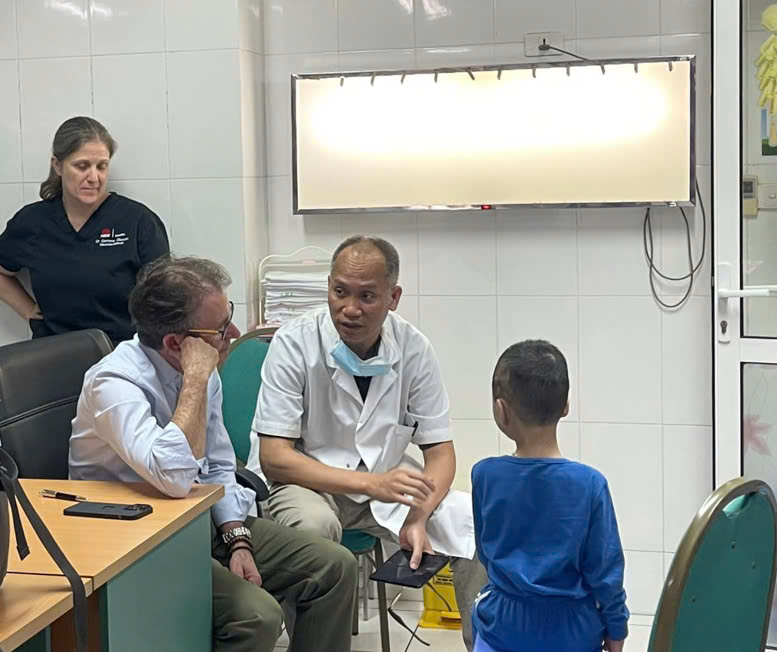
Hanoi, May 26, 2025 – As part of the official visit to Vietnam by President of the French Republic Emmanuel Macron., France’s First Lady, Madam Brigitte Macron, toured Viet Duc University Hospital, where she was warmly received by Dr. Nguyễn Tri Thức – Vice Minister of Health; the Board of Directors of Việt Đức Friendship Hospital; and many department and unit leaders. Dr. Nguyễn Hồng Hà was among the members of Vietnamese medical professionals, represent 2,400 hospital’s staffs, to welcome the French delegation. Dr Ha is a leading plastic and aesthetic surgeon with deep connections to the French medical community. As a senior surgeon in the Department of Plastic, Maxillofacial, and Aesthetic Surgery, Dr. Hà accompanied Madam Macron during her visit, including interactions with patients and medical staff. Dr Ha played as a brigde to underscored not only the diplomatic significance of the visit but also the longstanding collaboration between Vietnam and France in healthcare. An alumnus of the French College of Plastic Reconstructive & Aesthetic Surgery, Dr. Ha completed five years of specialized training in France, equipping him with expertise that he has since brought to Vietnam. His contributions have helped integrate French medical advancements into Vietnam’s healthcare system. “It is an honor to accompany Madam Brigitte Macron today,” said Dr. Ha. “France has played a crucial role in shaping my career, and I am proud to contribute to the ongoing partnership between our countries.” During the visit, Madam Macron engaged with patients and medical staff, particularly at Dr. Ha’s department, which has maintained strong ties with prestigious French medical institutions in Limoges and Strasbourg. This long-standing collaboration reflects the shared commitment to medical training, technology transfer, and hospital development. Madam Macron’s visit marks another milestone in Vietnam-France medical cooperation, highlighting leaders like Dr. Ha who continue to drive progress and enhance healthcare standards through international partnerships.

Come to Vietnam for Medical Treatment, why not?
A lesser-known fact: Vietnam, along with a few of the world's most advanced countries, can perform certain specialized medical techniques. One such example is the treatment of microtia, a congenital ear malformation. Typically, a normal ear measures around 3 cm by 6 cm, but some children are born with ears as small as a pea, a peanut, or sometimes no ears at all. The occurrence of this defect varies globally, affecting approximately 1 in 4,000 to 1 in 9,000 live births. In Vietnam, there are an estimated 150 to 200 new cases each year. Children with this defect often feel self-conscious and face significant challenges integrating into school life. Naturally, parents want their children to undergo surgery to reconstruct the ear. However, ear reconstruction is one of the most challenging procedures in cosmetic plastic surgery. That said, I can confidently state that Vietnam is a "powerhouse" in auricular reconstruction. In 2012, we handled a case involving the reattachment of a severed ear. When asked about the ear, the individual quickly searched a grass field and managed to retrieve it within the crucial six-hour window for successful microsurgical reattachment. This marked Vietnam's first case of microsurgical ear reattachment and one of the world's first five successful cases without postoperative complications. Microsurgery to reconnect arteries and veins in a completely severed ear is extremely rare and challenging. In severe trauma cases where the detached ear is crushed or in congenital deformities where there’s no ear to reattach, the surgeon must reconstruct the auricle. Even in this field, Vietnam leads the way. The ear has 15 to 20 different ridges and depressions. Structurally, the auricle comprises a thin white cartilage layer inside, covered by pink subcutaneous tissue, and a durable outer layer of thin skin. Ear reconstruction requires creating a delicate yet sturdy 3D cartilage framework before overlaying it with the thin skin layer. If the skin is too thick, the ear ridges won’t form; if too thin, the cartilage may protrude and become necrotic. Improper technique can result in the ear resembling a potato or fungus. The ear's vascular system includes tiny blood vessels that are only a third the diameter of a toothpick. Surgeons must use super-microscopes to suture these vessels with threads as fine as one-tenth the thickness of a hair. The complexity of ear reconstruction is so high that the global Ear Surgery Association has only about 200–300 qualified surgeons. Traditionally, doctors worldwide use the patient’s own rib cartilage for ear reconstruction. This method requires two to four surgeries, including harvesting rib cartilage, sculpting it into an ear framework, implanting it under the skin, shaping the ear, and refining the ridges and lobes. Using rib cartilage can lead to complications such as pneumothorax or significant postoperative pain. Patients must also wait until they are at least 10–12 years old to have sufficient cartilage for the procedure. In Vietnam, we now use a new U.S.-developed technique, reconstructing the auricle in a single surgery using an artificial cartilage framework. Children as young as four can undergo the operation. However, this method is particularly challenging. Only two or three centers worldwide can perform it, including Vietnam. The key lies in harvesting a thin yet strong temporoparietal fascia while preserving its tiny blood vessels. Vietnam's success stems from extensive experience with microsurgery and endoscopy. Auricular reconstruction with endoscopic assistance in a single surgery is a technique unique to Vietnam and the U.S. Patients from around the world seeking this new procedure must travel to the U.S., where it costs (for the operation). Neighboring countries like Singapore and South Korea still use traditional methods. Parents (from Viet Nam) who want their children treated abroad for congenital ear deformities face costs of 2–3 billion VND (Around $80,000 – $120,000). Whereas, many major hospitals in India, Thailand, Indonesia, France, Germany, and Switzerland invite Vietnamese experts to perform ear surgeries or send delegations to Vietnam for training. Vietnam achieves remarkable feats, yet international patients remain unaware that they should come here for treatment. Beyond ear surgery, Vietnam has approached the highest global standards in many medical fields. However, my concern is why foreign patients are unaware of Vietnam as a destination for medical interventions. Vietnamese doctors achieve results comparable to those in the most advanced countries, but at only 25–30% of the cost, even for long and complex surgeries. Vietnam has the potential to become a leading global hub for advanced medical services, which could generate significant foreign revenue. However, the reputation of Vietnamese healthcare does not yet reflect its true capabilities. International perceptions often view Vietnam as a developing country with underdeveloped medical infrastructure and services. Yet, Vietnamese healthcare has made significant strides in recent years. Public hospitals have opened international-standard departments with improved services. Many private hospitals strive to meet international quality standards, collaborating with experts from public hospitals to introduce new technologies and techniques. Recently, not only the public hospital where I work but also a private international hospital received global accreditation from the Royal College of Surgeons (RCS). Some Vietnamese doctors, including myself, have been recognized as global lecturers by this prestigious organization. Despite these commendable efforts, the retention of domestic patients has only slightly improved. The number of foreign patients coming to Vietnam remains modest, partly due to inadequate promotion of Vietnamese healthcare. From a national perspective, Vietnam has the potential to become a leading center for high-quality medical services, capable of performing even the most complex surgeries for international patients. The main challenge now is effectively communicating this capability to the world. It's crucial to highlight that Vietnam offers high-quality services at reasonable costs, making it an attractive destination for medical interventions. Currently, only a small group of top international surgeons recognizes the capabilities of Vietnamese doctors. With more systematic promotion, Vietnam’s reputation in ear surgery and other medical fields could reach a global audience. Coordinating efforts between public and private hospitals to enhance expertise and service quality must go hand-in-hand with developing effective communication strategies. This synergy would help Vietnam's healthcare sector seize meaningful opportunities. Assoc Prof. Dr. Nguyen Hong Ha

HIBC: The Premier Destination for Otoplasty in Hanoi, Vietnam
When it comes to correcting prominent or misshapen ears through otoplasty, finding a trusted specialist is essential. In Hanoi, HIBC (Hanoi International Beauty Center) stands out as a leading institution, offering world-class aesthetic surgery services with a focus on precision, safety, and natural-looking results. At the helm of this center is one of Vietnam's most esteemed plastic surgeons— Assoc. Prof. Dr. Nguyen Hong Ha , whose reputation in the field makes HIBC the top choice for otoplasty and other facial aesthetic procedures. A Renowned Leader in Aesthetic Surgery Assoc. Prof. Dr. Nguyen Hong Ha currently serves as the Chief of the Department of Plastic and Aesthetic Surgery at Vietnam-Germany Friendship Hospital in Hanoi, one of the country’s most prestigious medical institutions. With decades of experience in plastic and reconstructive surgery, Dr. Ha has built a career defined by excellence in clinical practice, groundbreaking research, and a commitment to advancing the standards of aesthetic medicine in Vietnam. Patients from across the country—and even internationally—seek out Dr. Ha not only for his technical proficiency but also for his compassionate approach and personalized care. His deep understanding of facial anatomy and aesthetics ensures that each otoplasty procedure is tailored to the individual’s unique facial structure and cosmetic goals. What Sets HIBC Apart? HIBC combines advanced surgical techniques, state-of-the-art facilities, and the visionary leadership of Dr. Nguyen Hong Ha to provide the highest standard of care in otoplasty. Here’s why patients trust HIBC: Otoplasty at HIBC: What to Expect At HIBC, otoplasty is typically performed under local anesthesia with sedation, making it a safe outpatient procedure. The surgery involves making precise incisions behind the ears to reposition, reduce, or reshape the ear cartilage. Recovery is generally swift, with most patients returning to normal activities within a week and enjoying full results in a few months. Patients often report a significant boost in self-confidence and satisfaction with their appearance post-surgery—testament to the transformative nature of this seemingly minor but deeply impactful procedure. A Reputation Built on Trust and Results Dr. Nguyen Hong Ha’s dual role as a surgeon and educator ensures that the latest innovations in surgical technique are always part of HIBC’s practice. His contributions to academic research and surgical training have made him a respected authority in Vietnam and beyond. Whether you’re seeking corrective surgery for prominent ears or a more refined ear shape, HIBC in Hanoi offers the best in otoplasty —led by a world-class surgeon committed to artistry, safety, and patient well-being.